TN Clean Fuels Press Release: Tennessee Tech Unveils New DCFC Unit in Cookeville as Part of “EV Testbed” Project
July 29, 2020

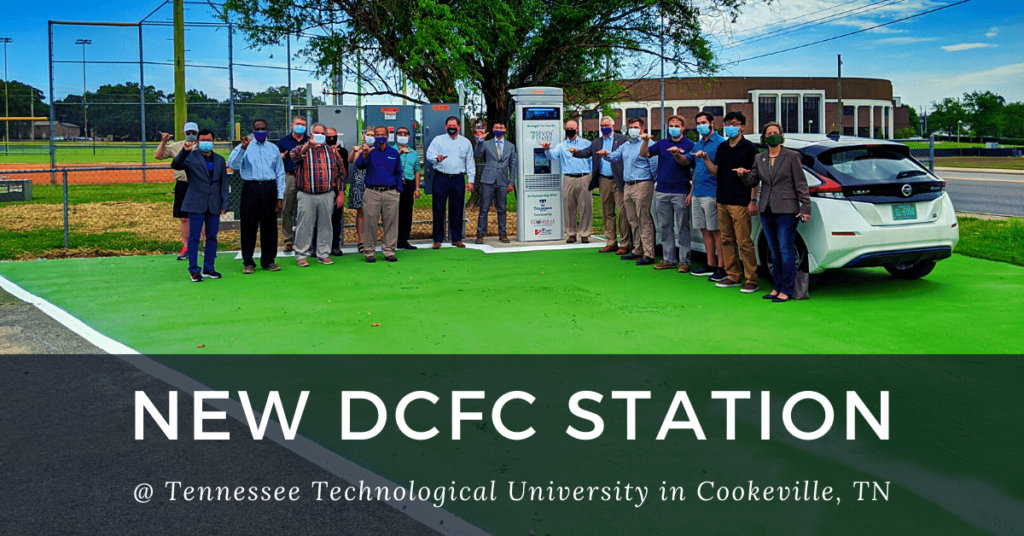
On July 22,  Tennessee Technological University  (Tennessee Tech, or TTU) unveiled a new  Direct Current Fast Charging  (DCFC) station that will serve a  U.S. Department of Energy -funded project started in 2019, as well as the greater Cookeville area. The unit was installed in a TTU parking lot along a busy corridor in Cookeville and will be the primary refueling site for an all-electric E450 shuttle bus that is part of the same DOE project. Lead project infrastructure partner  Seven States Power Corporation  managed the installation.

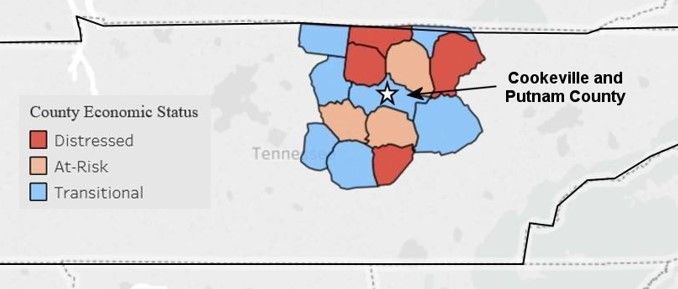
TTU was awarded and started that three-year DOE project last year, towards “developing an Electrical Vehicle (EV) Testbed in the 14-county ‘Upper Cumberland’ region of Tennessee.” The region is a largely rural area and includes a number of economically distressed counties (see map below). The grant’s Principal Investigator,  Dr. Pingen Chen , is an Assistant Professor in TTU’s Department of Mechanical Engineering and has brought a diverse group of about 10 partners into the project.

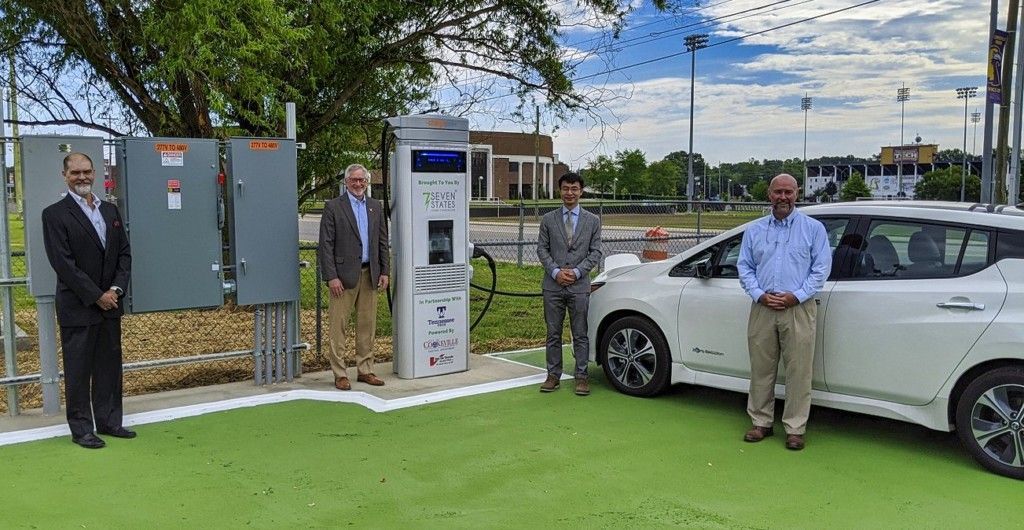
Three men are standing next to a white electric car at a charging station.
Left to right: East Tennessee Clean Fuels Coalition Executive Director Jonathan Overly, TTU President Dr. Philip Oldham, Project PI and Assistant Professor of Mechanical Engineering Dr. Pingen Chen, and Seven States Power Corporation Director of Distributed Energy Resources Brad Rains all stand with the new DCFC unit that will serve the project and community.

One component of this multifaceted project is the installation of nine EV charging units throughout the Upper Cumberland region. The first of the nine EV charging units is the DCFC unit that was installed at  320 University Drive, Cookeville, TN 38501. In the coming months, the remaining eight EV charging stations – all of which will be Level-2 stations – will be installed in select locations in the surrounding counties in the following cities:  Lafayette, Carthage, Livingston, Byrdstown, Jamestown, Smithville, Sparta and Spencer.

A map showing the economic status of cookeville and putnam county

The 14-county region in the project is along the Cumberland Plateau and in the central part of Tennessee, and has Cookeville as its largest city with a population of just over 35,000.

Combined, they will produce the beginnings of a charging network for the entire region that has largely had no focused EV-development efforts within it to date. Once the project is completed, it will have produced a “proof of concept roadmap” for how other rural areas across the U.S. can follow suit and help accelerate their development of EV charging and growth in use.

Another facet of the project includes procuring five electrified vehicles, which include three  Nissan Leafs , one all-electric E-450 passenger shuttle, and one plug-in hybrid F-250. “The three Nissan Leafs are ready to be used now for educational purposes, such as showcasing the value of electric vehicles through Ride and Drive or Show and Tell types of experiences specifically for our rural community,” said Dr. Chen. “Many times, in our state, we see plenty of EV opportunities and accessibility available in metropolitan cities, whereas rural communities are not prioritized. Our goal is to provide information, education, and a variety of EV experiences and opportunities for business leaders and community members to have access to this new automobile technology and to help inform their buying decisions.”

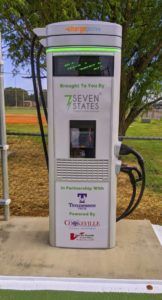
A 7 seven states charging station with a tree in the background.
The new ChargePoint DCFC unit has cables for both the CHAdeMO and SAE Combo standards and connectors.

Also, in attendance at the DCFC unveiling was TTU’s President, Dr. Phillip Oldham. “We are pleased with Dr. Chen’s EV initiative at TTU. This project fits well within TTU’s Grand Challenge Initiative called  Rural Reimagined which focuses on how the university will harness science, technology, and innovation to transform rural living,” said President Oldham. “Tennessee Tech serves more distressed counties than any other state university in Tennessee and is centrally located to eight counties in great need. We have an opportunity where this EV initiative can drive change through developing partnerships that will help transform our rural community. We find this opportunity energizing and a step-forward for Tech and our community overall.”

While the Nissan Leafs will be utilized to showcase EV operations and driving ease to individuals and fleets in the entire region, the E-450 shuttle will be used specifically by the transportation department of the Upper Cumberland Human Resource Agency. They plan to first utilize a TTU and downtown Cookeville route to operate the shuttle, but after any initial problems are worked out and the shuttle has proven its reliability in service, the department plans to move it to other routes around the 14-county region. Finally, the plug-in hybrid F-250 was specifically chosen as ‘best choice’ for getting farmers in the counties to test drive an electric vehicle. Jonathan Overly of ETCleanFuels notes, “if we really wanted to change the region’s farmers opinions about EVs, we thought that range restriction could make them test driving an EV a nonstarter. Thus, we elected to go with a plug-in hybrid so that they could finish any chore or task that they might handle on any given day.” The three Leafs are already in use, while the E-450 and F-250 are still in the process of being converted by those respective partners, Phoenix Motorcars and XL Fleet.


TTU’s project includes partnerships with  Nissan North America , the  East Tennessee Clean Fuels CoalitionChargePointSeven States Power Corporation , the  Upper Cumberland Human Resource Agency , the  University of Texas at AustinPhoenix MotorcarsLyft  and  Oak Ridge National Laboratory.


For more information about this grant and project, contact Dr. Pingen Chen at  pchen@tntech.edu .

To view this press release in PDF format,  click here.
By Jessica Bradshaw December 15, 2025
Leading Decatur Utilities as General Manager, Ray Hardin strives to ensure their system is prepared for the future with innovative solutions. We asked him to share some of the ways he’s implemented technology in his LPC’s footprint. “Advanced Metering Infrastructure (AMI) has helped us improve efficiency, maintenance, and long-term planning, while providing customers with usage data through the customer portal that enables them to look for ways to reduce their energy consumption and their cost. AMI has also integrated with the Outage Management and GIS Systems to improve outage tracking and reduce system downtime. We’ve also leveraged Demand Voltage Reduction technology to reduce the wholesale cost of electricity to keep customer rates as low as possible. And over several years, we have implemented LED streetlights throughout the City of Decatur, replacing less efficient lighting and saving the city on lighting costs.” Ray knows his LPC is responsible for the present and future of his community’s needs, and he wants his community to know that he strategically evaluates new technology with a long-term vision. “I want our customer to know that through our implementation of AMI, improved communications, Demand Voltage Reduction and other programs, we continue to look for ways to keep our system safe and reliable and provide the best service to our community at the lowest possible rates.” With so much technological advancement in the Valley, Ray encourages fellow leaders to lean on strategic partnerships to help bring about community change and benefits using cost-efficient solutions.  “Don't go it alone! Seven States, TVA and other agencies bring a wealth of resources that can be leveraged to bring innovation to a local community without breaking budgets. For example, Decatur Utilities was able to install two Level 3 Rapid EV Chargers in our community through a partnership with the City of Decatur, TVA, Seven States, and ADECA. It would have been difficult for us to justify the cost of such a project on our own - but through this partnership, the cost was shared while the benefit to our customers and communities is enormous. Seek out those opportunities for shared funding that will benefit your local area and lean on others who have already researched or implement innovative technologies to get their ideas and advice.”
By Jessica Bradshaw December 15, 2025
As Chief Information Officer for North Georgia Electric Membership Corporation (NGEMC), Brian Childers knows how crucial innovative partnerships and technology are in preparing for the grid of the future. Brian’s extensive experience has given him a deep understanding of technological diversity and strategic partnerships. We asked him to share some of the ways their team brought innovation to the North Georgia EMC membership, as well as his experience with Seven States as a trusted partner. “The most needed technology developments in our footprint focused on improving reliability, security, and member service. Upgrades to SCADA systems enhanced grid monitoring and automation, allowing faster outage detection and restoration. Cybersecurity improvements were critical to safeguarding member data and ensuring uninterrupted service. Mobile workforce tools streamlined field operations, enabling quicker response times to outages and service requests. Additionally, the installation of distribution system sectionalizing equipment, supported by fiber expansion, improved fault isolation and communication across the network, significantly reducing outage durations and strengthening overall system reliability for our members. Seven States has helped our LPC support innovation by providing access to emerging technologies and collaborative opportunities. They also share best practices that keep us aligned with industry advancements and prepared for future member needs.” Brian always considers how their members view NGEMC’s investments in innovation. “I want our members to know that our role in innovation is centered on improving their quality of life and ensuring reliable, secure, and efficient service. We invest in technologies like advanced grid automation, fiber-supported communication systems, and modern outage management tools to deliver faster restoration, better reliability, and enhanced security. Every innovation we pursue is designed to strengthen our community—whether by reducing outage times, enabling smarter energy solutions, or supporting future connectivity needs. Our commitment is to keep members at the heart of every technology decision we make.”  Brian has learned that being plugged into your community and knowing their needs is fundamental to being an innovative leader. He offered this advice to others who might have questions about how to start bringing innovation to their LPC. “NGEMC’s territory includes communities served by multiple power providers, which limits large-scale community investments. Because of this, innovation should focus on projects that deliver clear, measurable benefits to members. Prioritize technologies that improve reliability while helping keep rates affordable. Stay informed on emerging trends like energy storage and flexible rate options while communicating openly with members to encourage adoption. Above all, maintain a long-term vision that balances innovation with financial responsibility, ensuring every investment strengthens member trust and delivers lasting value.”
By Jessica Bradshaw October 27, 2025
Cleveland Utilities connects Cleveland to Fast Charge TN and regional Fast Charge Network
Show More